How Shelter Helped Patrice
As of July 1, 2026, the Ramsey County Family Service Center is no longer operated by Catholic Charities Twin Cities. The care provided there over nearly three decades reflected the very best of Catholic Charities and made a meaningful difference in the lives of countless families. Thank you to everyone who supported this lifechanging work.
Losing Housing and Seeking Shelter
Patrice is a mother and grandmother who has always taken care of her family, regardless of the many hardships that have come her way. As of last September, she and her two teenaged granddaughters were happily living together, and Patrice had a good job as a caregiver at an assisted living facility. But suddenly their lives were completely uprooted.
It was the time of year when her grandkids were getting back into their school routine, and the morning had been busy. Patrice was at work when she got a bad feeling about something. “I usually got done with work at 4:30 p.m. but something told me to go home, so I left at 2:30 p.m. that day,” Patrice remembered. “When I got back to my apartment, there was a crowd of first responders and neighbors standing around my door – it had burned completely and was still smoking.”
Patrice received a candle as a gift from a coworker earlier that week, and she was horrified to realize that she must have accidentally left it burning. In complete shock, Patrice frantically tried wiping soot off the blackened walls and couch. It took a while before reality set in; she wouldn’t be able to save their home. At that moment, Patrice remembered that her granddaughters were returning from their basketball game soon. She needed to come up with a plan, fast.
Shelter: A Safe Place to Go
Fortunately, Patrice’s grandchildren had a friend at school whose family was able to temporarily take them in. But with nowhere for herself to go, and no family to fall back on, Patrice made her way to Catholic Charities Dorothy Day Place in downtown St. Paul to spend the night. For the next three weeks, she continued to work and relied on the emergency shelter while looking for somewhere she could be safe with her granddaughters.
After 20 days downtown, Patrice secured a spot at Catholic Charities Family Service Center in Maplewood – a shelter for families that provides wraparound services to help obtain permanent housing.
Following the traumatizing and exhausting experience of losing her home, Patrice remembered the relief she felt at the Family Service Center. “When I got welcomed at the door, suddenly everything changed,” she said. “It was like I could finally rest mentally – and I was so grateful to be somewhere comfortable with my grandkids again.”
“This place has been like a safety net for me, and the people here have your back,” explained Patrice. “I’m getting back on my feet – and I’m doing it for my granddaughters.”
Working Hard and Making Progress
Patrice was also glad to discover that the Family Service Center already contacted the school district about transportation so her granddaughters could easily travel to their high school. And while the girls were at school each day, Patrice took advantage of the resources available at the shelter.
Patrice continued to work and save money and spent her free time studying in the computer lab to get a Community First Services and Supports (CFSS) certificate – a key certification for professional caregivers. Now, Patrice has her eyes on an apartment in St. Paul and wants to turn her past traumatic experiences into a skillset that she can use to help other people.
“This place has been like a safety net for me, and the people here have your back,” explained Patrice. “I’m getting back on my feet – and I’m doing it for my granddaughters.”
Experiencing Homelessness as an Elder
Experiencing Homelessness as an Elder in Minnesota
Lee is a classic Minnesotan — he has lived his whole life in White Bear Lake and his ideal vacation includes fishing and sleeping under the stars in the Boundary Waters Canoe Area Wilderness.
But Lee’s life has been challenging for as long as he can remember. Lee lost his father unexpectedly in high school and had to drop out to help pay rent. Lee spent most of his adult life supporting his mother, and making ends meet was never easy.
When Lee started a new career as a trailer mechanic, he was hopeful that it would improve their situation. But one day, Lee slipped at work and severely damaged his knee. Lee needed knee surgery and couldn’t return to work for a while. During Lee’s recovery, he was rear ended on the way to one of his medical appointments. The accident nearly killed him. “I got hit at about fifty miles per hour,” Lee stated, “and it permanently messed up my neck and back.”
Trying to Save Their Home
Lee’s mother fell ill shortly thereafter in 2011. Lee was still unable to work and suddenly found himself responsible for his mother’s caretaking. “I was the only one who could take care of my mom, and we were already struggling just to keep a roof over our heads,” he said.
Lee eventually found sporadic work and accomplished his goal of keeping his mother in their home until she passed away in 2019, but at a serious cost to his own health. During those 8 years, Lee’s back and neck problems worsened, leaving him with mobility issues and chronic pain. Minnesota’s COVID-19 rent relief program allowed Lee to maintain his housing during the pandemic, but when assistance ran out in the summer of 2022, he ended up being evicted — two months after his 50th birthday.
Nowhere to Turn
Without anywhere to go or family to turn to, Lee began sleeping in the woods near his neighborhood.
“I couldn’t move around very well and sleeping on the ground with chronic pain is like torture,” Lee explained. “But I wanted to stay in the community I’d been in my whole life.”
Lee had a daily routine of going to the public library in White Bear to charge his phone and rest before returning to the woods to sleep. But one night a nasty storm blew through town and destroyed Lee’s camping setup. He was forced to abandon his belongings and call an ambulance for himself that night.
“I’ve got my eye on an apartment that’s only a block away from where my mom is buried in White Bear Lake,” Lee said. “It would be a perfect fit for me — I can’t wait to get back home.”
Resetting at Dorothy Day Place
Upon his release from the hospital, Lee was brought to the Dorothy Day Place campus. “I don’t know if someone was smiling down on me or what, but I was fortunate to get a shelter bed right away,” Lee remembered.
After six weeks in the overnight shelter, Lee moved into Focus Forward, a Catholic Charities program that offers intensive case management to help connect people with housing as quickly as possible. The programs serve people of many different circumstances, including elders experiencing homelessness in Minnesota. Lee described how the resource coordinator at Dorothy Day place made a difference for him: “She was like a godsend. She was kind to me right away, got me started with my paperwork, and even advocated for me when my eligibility for benefits was unclear.”
Now, Lee is in better health and is doing everything in his power to secure housing and work.
“I’ve got my eye on an apartment that’s only a block away from where my mom is buried in White Bear Lake,” Lee said. “It would be a perfect fit for me — I can’t wait to get back home.”
How a Family Experiences Homelessness
As of July 1, 2026, the Ramsey County Family Service Center is no longer operated by Catholic Charities Twin Cities. The care provided there over nearly three decades reflected the very best of Catholic Charities and made a meaningful difference in the lives of countless families. Thank you to everyone who supported this lifechanging work.
Suddenly homeless with nowhere to turn
Diana is the kind of person who puts others first. She is an experienced nursing assistant and a passionate mother who says that her children “mean everything” to her.
Diana moved to Minnesota at the end of 2021 in search of better opportunities for her family. Over the next six months, Diana did everything she could to establish a quality life for her kids. She found a good job, and her children were settling into their new home in Saint Paul. Diana was proud that she had kept her family safe and healthy through the coronavirus pandemic and was looking forward to the future.
That’s when disaster struck. A fire destroyed the duplex that Diana and her children called home — along with most of their belongings. “Just like that, we lost everything,” Diana said.
Suddenly, Diana found herself with no home and nobody to turn to for support. Her landlord wasn’t answering her calls, and she didn’t have any family who could help her. So, with no other options, Diana took her children to the nearest emergency shelter.
For the next year, Diana and her children lived in a few different shelters that serve families experiencing homelessness. Diana explained that some places were better than others, but it’s just hard to be in a shelter with young children — especially during the holidays. She couldn’t make them home-cooked meals, and they were constantly packing and unpacking their belongings. To Diana, it felt like no matter how much paperwork she filled out or how many calls she made, she would never find a place for her family.
Finding refuge at the Family Service Center
But in June 2023, Diana was connected with Catholic Charities’ Family Service Center shelter. “When I got to the Family Service Center, I felt so welcomed,” said Diana. “You could tell every morning that staff are happy and kind. They tell you that they care, and then prove it…you can always count on them being there to help.”
The Family Service Center shelters up to 21 families at a time in Ramsey County, but its main function is to help families experiencing homelessness obtain permanent housing. And at any given moment, there are up to 60 families on the waiting list, with an average wait time of 3 weeks. Staff do everything they can to get families connected with stable housing as quickly as possible.
With a strong team behind her, Diana worked tirelessly with case managers to find housing. It wasn’t an easy process — including chasing down leads that would fall through at the last minute, making calls and not hearing back, and jumping through hoops she didn’t even know existed. But after three months of persistence, and with help from the Family Service Center, Diana finally secured a new home for her family. After working toward this goal for so long, newfound hope took Diana by surprise.
“When I got to the Family Service Center, I felt so welcomed,” said Diana. “You could tell every morning that staff are happy and kind. They tell you that they care, and then prove it.”
Finding her way home
“I haven’t cried in a long time,” said Diana through tears. “These are happy tears, breakthrough tears. It’s a testimony to accomplishing something that I wasn’t sure I could … especially as a mom who’s only 28 years old and has little ones.”
Diana walked into Catholic Charities’ Family Service Center carrying the burden of the past year’s traumatic experiences. When she left, she carried some new paintings and the keys to a place that her family could call home. “I’ve been through a lot,” Diana said. “But this place really helped me … now I just want to sit back and watch my kids grow.”
For the first time since moving to Minnesota, Diana’s family will be home for the holidays. From marking her children’s heights on the wall, to hanging ornaments on a Christmas tree, having a place to live means stability for Diana’s family. More than anything, Diana is looking forward to building a foundation and creating core memories together with her family.
Carol’s Story: Elder Homelessness
A life changing phone call
Carol describes herself as “one tough cookie.”
Having grown up in an abusive home and later navigating her own journey to sobriety as a young adult, Carol learned that she could rely on herself to figure things out. But in January 2020, Carol received a life-changing phone call—her son, Erik, was in the hospital after experiencing a massive left-brain stroke. At only 49 years old, Erik had been busy working as a professional photographer in St. Paul when this tragic event derailed his life. The stroke left Erik with severe mobility issues and unable to speak.
Experiencing emergency shelter as an older adult
At the time, Carol was living in Wisconsin, far away from the hospital where Erik was receiving care. She was heartbroken to hear that Erik was likely going to need to stay in a nursing home while he recovered. “I knew I had to get back home to Minnesota to be with him,” Carol remembers.
Doing whatever she could to be closer to her son, Carol decided to stay temporarily at an emergency shelter in New Richmond, Wisconsin, about forty miles east of the Twin Cities. For months, Carol spent hours driving back and forth to manage the aftermath of Erik’s hospitalization. She moved belongings out of his apartment, made sure his beloved cat was cared for, and coordinated with Erik’s doctors as he recovered from heart surgery—yet another consequence of his stroke.
Carol eventually moved to a Minneapolis shelter location, but finding an affordable apartment in the Twin Cities remained out of reach. She desperately wanted to get Erik out of the nursing home, but at that point, the pandemic was running rampant. “I couldn’t even go and see him.” Carol remembers. “I was tearing my hair out.” Just when Carol was gathering the resources she needed to be able to move Erik, she contracted COVID-19.
Light at the end of the tunnel
Carol was required to stay in a COVID isolation room with others who were very sick. She describes this time as, “insane and scary. You’re so displaced and you just lose touch. There was no place to go for peace and quiet — to get away from everybody else’s problems so you could focus on your own.”
While Carol recovered from COVID, she was connected to Catholic Charities’ Homeless Elders program, which provides intensive case management and advocacy on behalf of vulnerable older adults. It was then that Carol met Case Manager Melea Blanchard. “If it were not for her, I don’t think I would’ve made it,” says Carol. “After I met Melea, I could see a little light at the end of the tunnel. It was like somebody actually cared.”
“After I met Melea, I could see a little light at the end of the tunnel,” says Carol. “It was like somebody actually cared.”
Homeless elders program helps Carol start fresh
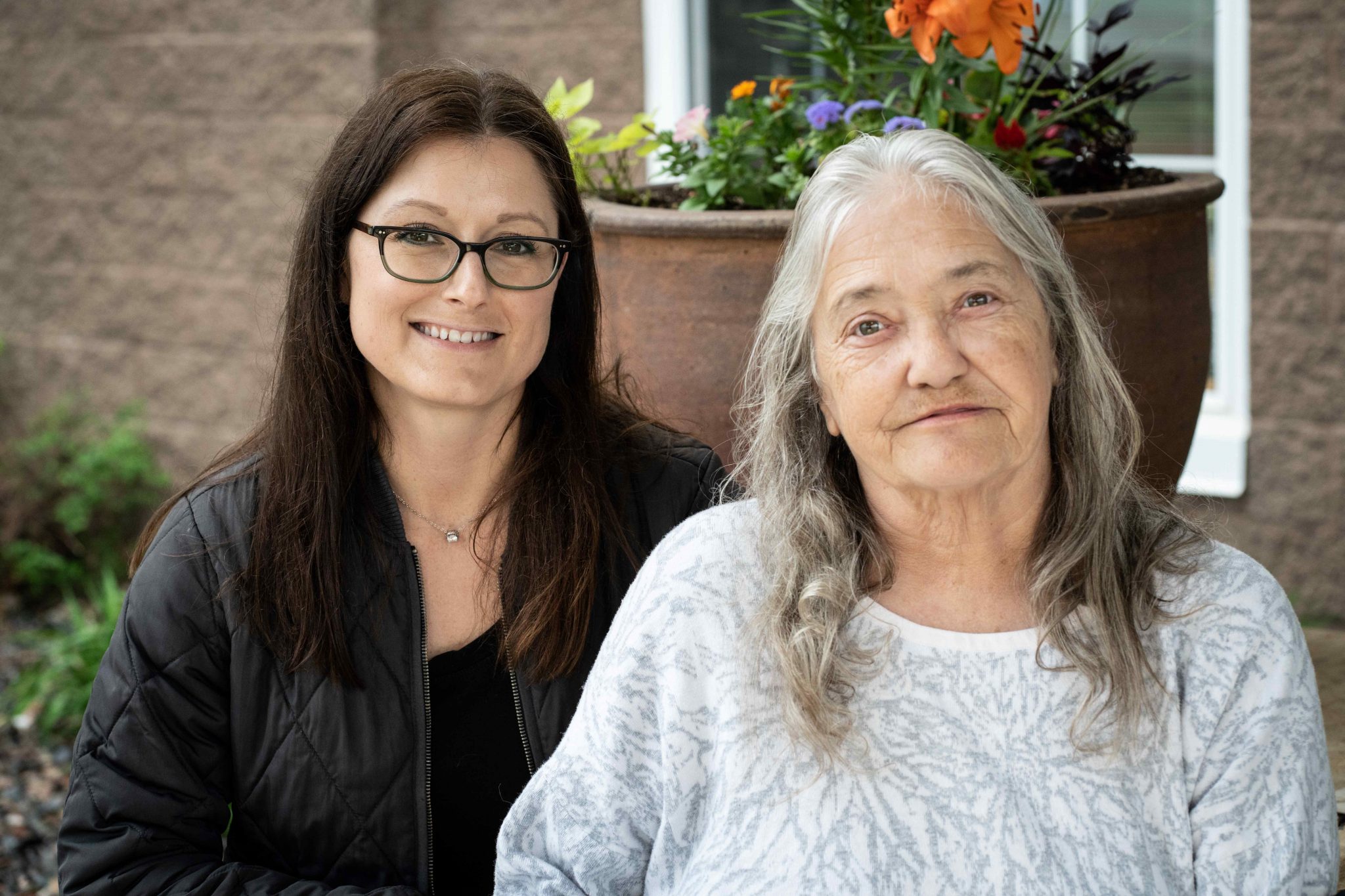
Melea worked to find housing for Carol that could also accommodate Erik. The two of them now live together in an apartment in St. Paul. “Since I have been out of the shelter, and Erik could come home, I think he has improved significantly,” Carol shares.
With stable housing, Carol has been able to manage her own health and secure resources for Erik as he works through speech and physical therapy. They still face challenges, but with a place to call their own—Carol says, “We are doing the best we can with what we’ve got.”
Carol lent her lived expertise at the Minnesota Capitol this year, testifying in support of Catholic Charities’ Homeless Elders program. “I’m an activist at heart”, Carol says, “seniors are not disposable. We are not stupid. We deserve dignity and respect.” With Carol’s help, legislation was passed that will make a difference for other older adults facing homelessness or in need of other support in our community!
A Program that Focuses on the Future
Meet Matthew
One year ago, Matthew was released from Hennepin County Jail with nowhere to go.
Struggling with addiction, this had not been Matthew’s first time in jail—but this time he had no one to call, nowhere to stay for the night. He hopped on the light rail without knowing which direction it was headed and rode it all the way to Saint Paul, where some outreach workers connected him with a shelter bed.
Focus Forward is a program started in partnership with Ramsey County to provide extra help to those left behind during the pandemic — Catholic Charities staff noticed that some people weren’t finding their way out of emergency shelter, so we pivoted our service structure to meet the needs of our community.
“One step forward and two steps back”
Over the next nine months, Matthew orbited the supportive services at Dorothy Day Place campus, where he slowly got to know Case Manager Michael Kaup. Eating his meals indoors but frequently opting to sleep in his truck parked outside, Matthew describes that time as feeling like “groundhog day”. But, one day he noticed that his legs were extremely swollen.
“I ended up taking a bus down to the hospital, going to the emergency department,” Matthew remembers. There, he was devastated to hear that the edema in his legs was caused by congestive heart failure. At only 44 years old, drug use and homelessness had taken a harsh toll on his body. Still, Matthew explains, “no one is ready to hear that.”
While hospitalized for the next two months, his doctors added an additional diagnosis: schizophrenia. Matthew suspects that he may have unknowingly been experiencing symptoms for a long time, something that is all too common amongst people experiencing homelessness.
Finding Focus Forward
After being discharged from the hospital, Matthew returned to Dorothy Day Campus. There, Case Manager Michael Kaup referred him to Focus Forward, an enhanced shelter program that works to quickly connect people with housing once they’re ready to take the next step. While staying at Focus Forward, Matthew felt safe to get good sleep, eat regular hot meals, and work with a case manager to navigate supportive services that would help build a more stable life.
Now, Matthew is more than 90 days sober. He’s living in housing that supports his sobriety, spends time at an Addiction Health Center, and is doing everything he can to improve his health.
“I’m fairly certain that Focus Forward saved my life,” Matthew said, “I could focus more on what I needed to do, and I was getting sound sleep . . . you know, just all those things people need when they are looking for new opportunities.
I hope for the best and no longer want to expect the worst. I want to share my story because if people can understand somebody in my position, it gives me hope for the future.”